Every operations team has the same hidden dependency: the engineer who has been there the longest. They know why the firewall rule exists, what happened the last time that service restarted, and which alert is safe to ignore. When they are on vacation, the team moves slower. When they leave, the team loses months of context that was never written down. This post is about the system built to break that dependency — a knowledge base that captures decisions and incidents as they happen, consolidates them into a searchable corpus, and makes the next incident faster to resolve because the context from the last one is already there. Not a wiki that someone is supposed to update eventually. A loop that captures knowledge as a byproduct of doing the work.
The problem with “document it later”
The standard advice is “document your infrastructure.” The standard outcome is that nobody does, because documentation is a separate task that competes with the actual work. An incident happens at 2 a.m., the engineer fixes it, and writing the runbook is a task for tomorrow. Tomorrow has its own incidents. The runbook does not get written. Six months later, the same incident happens, and the team re-derives the fix from scratch — because the engineer who solved it last time remembers the gist but not the command, and there is no record.
The failure is not laziness. It is architecture. A knowledge base that depends on people remembering to update it will drift out of date the moment the first deadline arrives. The system that works captures knowledge as a side effect of the work itself — the incident ticket, the decision record, the RCA draft — and routes it into a consolidation pipeline that turns raw notes into maintained documentation.
The capture layer
The first stage of the loop is capture: writing down what happened, while it is happening, in a form that can be consolidated later. Three capture points cover most of the value:
Incident records. Every incident that triggers a page or a manual intervention gets a record — the timeline, the symptoms, the fix, and the follow-up. The record is written during the incident, not after. It does not need to be polished; it needs to be accurate. The polish happens at the consolidation stage.
Decision logs. Every architecture decision that will matter in six months gets a decision record — the context, the options considered, the choice, and the reasoning. “We chose Proxmox over VMware because of per-core licensing costs at our scale” is a decision record. “We set the alert threshold to 80% because the baseline showed normal load at 65%” is a decision record. The test is: will someone in six months wonder why this is the way it is? If yes, it gets a record.
RCA first-pass drafts. After an incident, someone has to write the root-cause analysis. An agent that assembles the timeline from logs, alerts, and deploys — and drafts a first-pass hypothesis list — turns a two-hour documentation chore into a thirty-minute review. The engineer corrects the draft; the correction is where their judgment lives. The corrected RCA goes into the knowledge base as the canonical record of what happened and why.
The consolidation layer
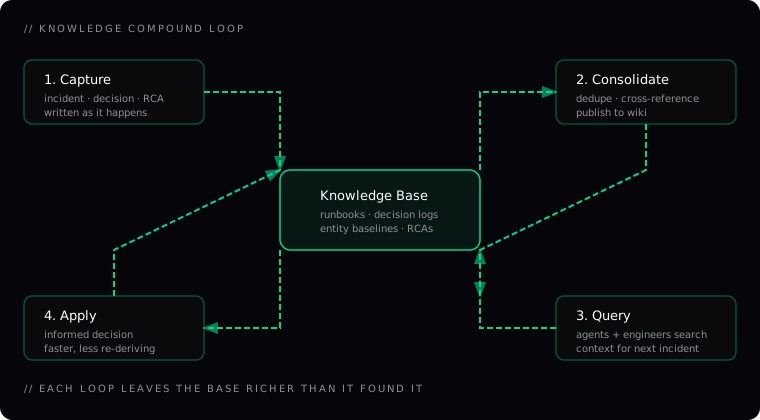
Capture produces raw notes. Consolidation turns them into maintained documentation. This is the stage that most knowledge systems skip, and skipping it is why most wikis are graveyards of half-finished pages.
The consolidation pass cross-references new notes against the existing corpus. A decision record about alert thresholds links to the incident that prompted the re-tuning. An RCA links to the runbook that was updated as a result. A new runbook links to the decision record that explains why the procedure is the way it is. The output is not a pile of pages — it is a graph of related context that an engineer (or an agent) can traverse to understand not just what to do but why.
The consolidation is not a one-time effort. It runs on a cadence — weekly, when the volume of new notes warrants it — and it is the job of a dedicated role, not a side task for the engineer who wrote the notes. The engineer’s job is to capture accurately. The consolidator’s job is to organize, deduplicate, and cross-reference. Separating these roles is what keeps both from being skipped.
The query layer
A knowledge base that nobody can search is a knowledge base that nobody uses. The query layer is what makes the corpus useful in the moment that matters — when an engineer is looking at an alert at 3 a.m. and needs to know whether this has happened before.
Full-text search across the corpus. The knowledge base is indexed end-to-end — runbooks, decision records, RCAs, entity baselines. A search for “Zabbix alert CPU spike API tier” returns the incident record from three months ago, the runbook that was written in response, and the decision record that explains the current threshold. The engineer does not need to know which page to look at; the search finds the relevant context across all of them.
Agent-assisted retrieval. An agent that has access to the knowledge base can answer “has this happened before?” in seconds — pulling the relevant records, summarizing the prior fix, and pointing at the runbook. The agent does not make the decision; it brings the context to the engineer who does. The value is not the agent’s reasoning — it is the agent’s ability to search a corpus faster than a human can at 3 a.m.
Context attached to alerts. When an alert fires, the alert notification includes a link to the relevant runbook — not a generic “see the wiki” link, but a direct link to the runbook for that specific alert. The engineer starts with the context, not with a search. This is the integration between the monitoring stack and the knowledge base that most teams miss: the alert should carry its own explanation.
What compounds
The loop is the point. Each incident that gets captured, consolidated, and made searchable makes the next incident faster to resolve. Each decision that gets recorded prevents a future re-derivation. Each runbook that gets written in response to an incident prevents the next occurrence from becoming an incident at all — because the runbook turns it into a procedure.
The compounding is measurable. Over the first year of operation, the time from alert to resolution drops as the corpus grows — the same knowledge-capture loop we install in maintenance engagements — not because the team gets faster, but because the context they need is already there. The number of incidents that escalate to “we need to wake up the senior engineer” drops, because the runbooks let the on-call engineer handle more without escalation. The number of incidents that repeat drops, because the RCA-driven follow-ups close the root causes.
That is the standard to hold any knowledge-management proposal to: not “what does it store?” but “what does it make faster next time, and who can find it when they need it?” The first answer makes a wiki. The second makes an operation that gets better with age instead of worse.